It keeps the books. You close them.
Every sale, bill and payment posts itself to a real double-entry ledger the second it happens. The agent reads what posted, raises what does not fit, and tells you what still blocks the close.
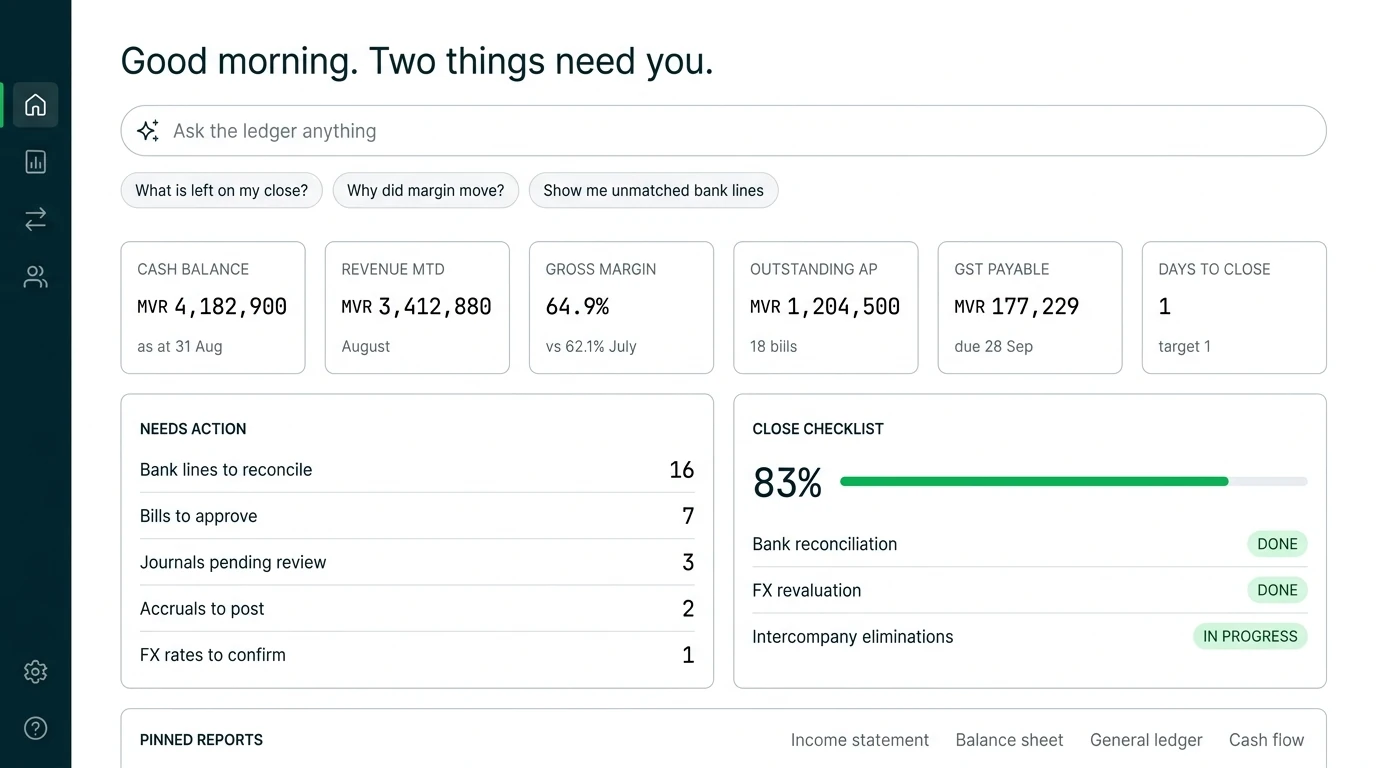
Most of the month happens without you.
Not a copilot waiting to be prompted. The posting, the scheduling and the revaluation run on their own, and you are called in for the judgement rather than the typing.
Transactions post themselves
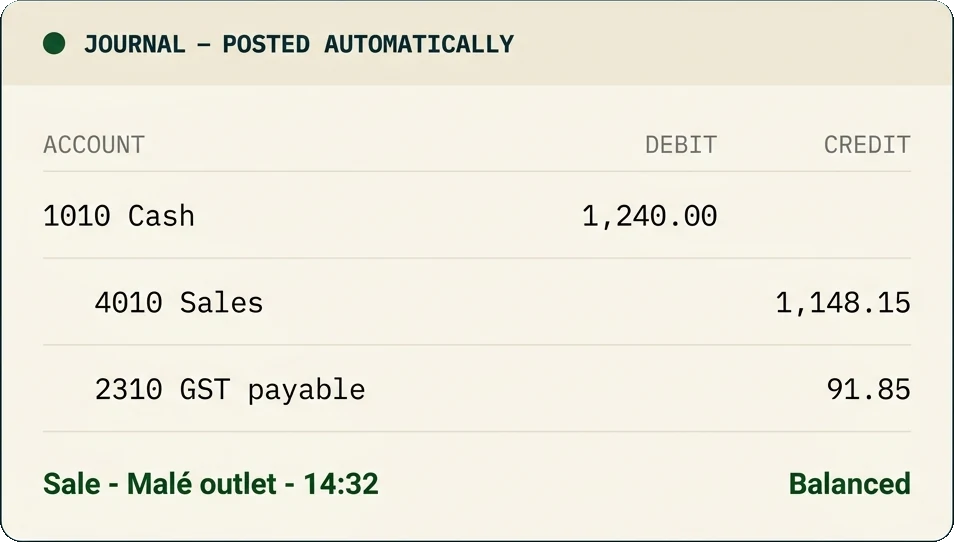
Every sale, bill, payment and stock movement lands in the ledger at the moment it happens — not on a nightly sync you have to trust.
The repeating work repeats itself
Recurring and reversing journals post on schedule, depreciation posts itself, and FX revalues on the rate you set.
Matching happens before you sit down
Rules clear the lines they can, so the reconciliation waiting for you is the exceptions and nothing else.

When it needs you, it shows its working.
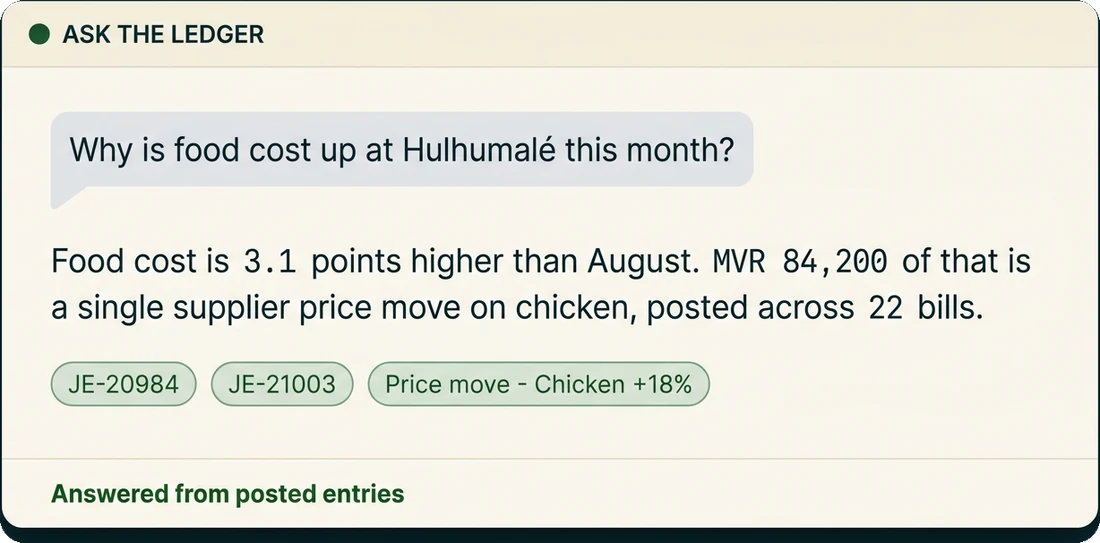
An answer you cannot check is a rumour. Every one of these is computed from posted entries, and cites them.
Ask in words, get a number you can check.
Ask why food cost moved, what a supplier has billed this quarter, or which outlet is behind. The answer comes back with the journal lines it was computed from, so you can open them and see for yourself.
It raises what does not fit.
Detection runs across posted activity and surfaces the entry that breaks the pattern — a duplicate bill, a price that moved without a reason, a posting to an account dormant for a year.

It knows what is still open.
During the close it reads the checklist the way a reviewer would: what is reconciled, what is accrued, what is still unmatched, and which of those actually blocks the lock.

It reads your ledger, not the internet.
The agent is scoped to your organisation and inherits the permissions of the person asking. It cannot see another tenant, and it cannot answer from anything but posted entries.

An agent is only as good as the ledger beneath it.
Most AI bolted onto accounting reads a copy of your numbers, synced hours ago, and hopes nothing has changed since. This one reads the ledger it wrote.
It answers from entries, not estimates
Every figure it gives you exists as a posted double-entry journal, written at the moment of sale. There is no window in which the books are quietly wrong.
One chart of accounts, every entity
Outlets, companies and projects post into the same structure, so the group view is a query rather than a project.
Drill all the way to the document
Any figure opens the entry, and any entry opens the bill, receipt or sale behind it.
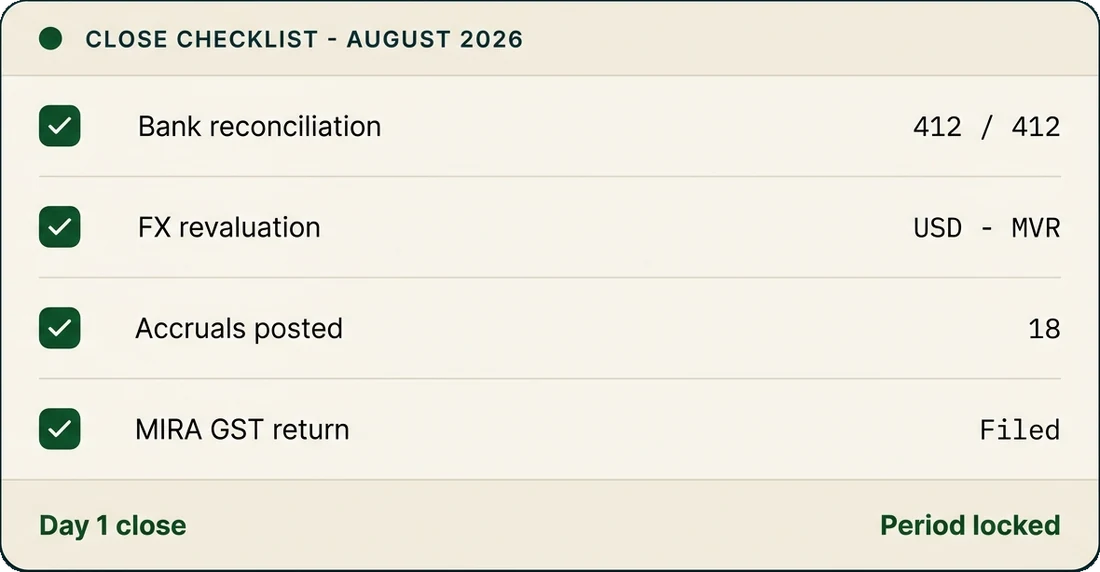
The close runs itself until it needs you.
Reconciliations, accruals, revaluation and locks, each with a state the agent can read. It works down the list and stops at the items that need a decision.
Bank reconciliation first
Rules match what they can; your team works only the exceptions.
Then accruals and revaluation
Recurring journals post themselves, and FX revalues on the rate you set.
Then the lock
A locked period cannot be posted into by accident, which is what makes last month trustworthy.
An auditor can check every step it took.
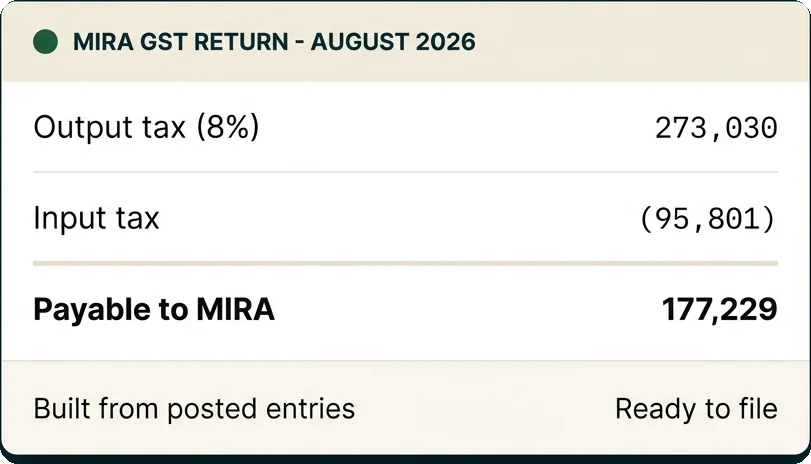
Multi-rate tax handled at the line, a return built from the ledger, and a trail that answers the question before it is asked.
GST returns from the ledger
Not reassembled from exports the week the filing is due.
Input and output statements
With the supplier TIN and invoice number the filing actually requires.
An unbroken trail
Every posting keeps who, when, and what it came from.
Eleven modules. One ledger. One agent.
Not eleven products that sync with each other. One system, so a figure means the same thing wherever the agent reads it.

It already knows where your numbers come from.
Sales, stock, purchasing and payroll post into the same ledger. Nothing here is a nightly export.
- Hubits POSSales
- Hubits InventoryStock
- Hubits PurchasingProcurement
- Hubits PeoplePayroll
- Excel and CSVImport and export
Coming off QuickBooks, Xero or Tally?
Migration is the reason most finance teams stay somewhere they have outgrown. Here is what it actually involves.
- 01
Your chart of accounts, mapped
We map what you already have rather than making you adopt ours.
- 02
Opening balances, verified
Trial balance in, trial balance out, agreed with you before you go live.
- 03
History where you need it
Prior periods come across, so your comparatives are real.
- 04
One period in parallel
Both systems, one month, side by side — so you switch on evidence.
Made in the Maldives, for Maldivian books.
MIRA GST, MVR and USD side by side, resort and multi-outlet structures, and the reporting an auditor here actually asks for. Not a global product with a local plugin bolted on.
MIRA is a feature, not an export
The tax return is part of the ledger, not a spreadsheet you assemble afterwards.
Two currencies, no gymnastics
MVR and USD held properly and revalued on the rate you set.
Built alongside the businesses using it
Designed with operators running multi-outlet books here, not in a product workshop abroad.
Questions a finance manager actually asks
What does it actually do without asking me?
It posts every sale, bill, payment and stock movement to the ledger as it happens, runs recurring and reversing journals on schedule, posts depreciation, revalues FX on the rate you set, and clears the bank lines its rules can match. Anything that needs judgement is raised for you rather than decided for you.
Does the AI make things up?
It cannot answer from anything but posted entries, and it lists the journal lines behind every figure it gives you. If it cannot cite the entries, it does not answer. It is also scoped to your organisation and inherits the permissions of the person asking, so it cannot read another tenant or an account you cannot.
How is this different from QuickBooks or Xero?
Those receive your numbers from somewhere else, usually on a sync, and any AI they add reads that copy. Hubits Finance is the ledger underneath the transaction, so the books are correct at the moment of sale and the agent reads the ledger it wrote. It also handles MIRA GST and multi-entity consolidation natively, which those products do not.
Can it handle MIRA GST?
Yes. Multi-rate tax is handled at the line, and the GST return, input tax statement and output tax statement are built from the ledger itself, with the supplier TIN and invoice number the filing requires.
We run several companies. Does it consolidate?
Yes. Entities are grouped into organisation groups that roll up to a consolidated view in one presentation currency, and any group figure drills back down to the entity and the entry behind it.
What does migration involve?
We map your existing chart of accounts rather than making you adopt ours, agree opening balances against your trial balance, bring across the history you need for comparatives, and run one period in parallel so you switch on evidence rather than faith.
How long does implementation take?
For a single entity with clean opening balances, weeks rather than months. Groups, and businesses with several years of history to bring across, take longer. We will tell you which you are after looking at your books.
Do you charge per user?
No. Pricing is per entity, and users are unlimited. Charging per seat encourages people to share logins, which destroys the audit trail.
Can our auditor get what they need?
Yes. Every posting keeps who, when and from what, any figure drills to its source document, and locked periods cannot be posted into by accident. Reports export to PDF and spreadsheet.
What happens to our data if we leave?
It is yours and it is exportable at any time, in full, including the ledger detail rather than just summary reports.